From seven clippings in Fort Wayne newspapers, 1889 to 1911.
Today Hurshtown is a road name and a reservoir. A century and more ago it was a place of its own, on the St. Joseph River north of Leo. The Fort Wayne papers called it “a small village in the northern part of Allen county” (1889), printed local news under the dateline “HURSHTOWN, Ind.” (1907), and by 1911 called it “the little trading point.”
A village
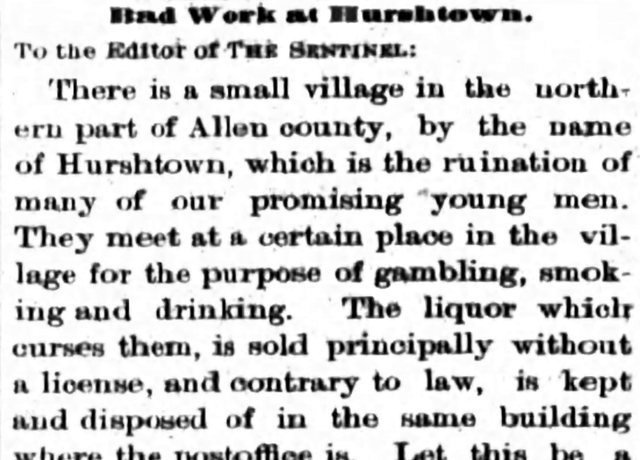
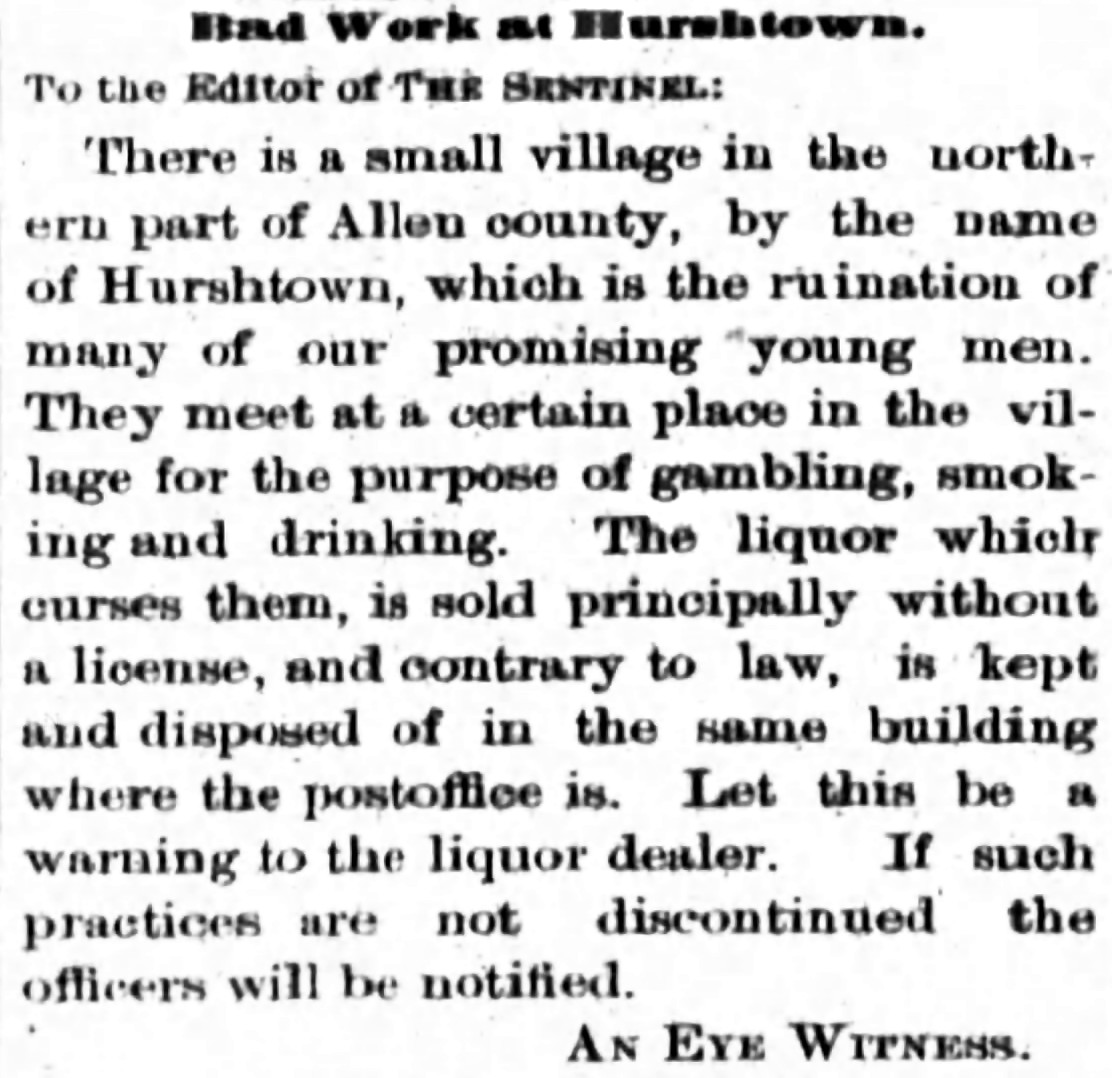
The Fort Wayne News and Sentinel, February 20, 1889. See the clipping
The earliest clipping is a complaint. In February 1889 an anonymous letter-writer described Hurshtown as a small village “which is the ruination of many of our promising young men.” They met there, he wrote, “for the purpose of gambling, smoking and drinking,” and liquor was sold “principally without a license” and kept “in the same building where the postoffice is.” Whatever else it shows, the letter places a post office at Hurshtown.
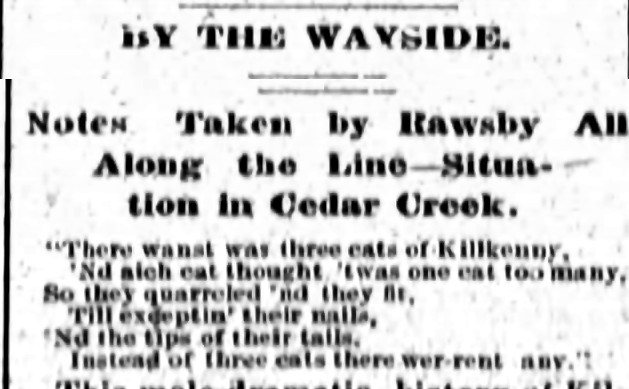
By 1894 Hurshtown carried weight in township affairs. A newspaper correspondent covering a quarrel over that year’s township ticket quoted a local boast that “Hurshtown is on top this year and running things to suit herself and that Leo and Cedarville can either like it or lump it.” The man he called “the boss of the Hurshtown gang,” Mark Mowdy, was the nominee for trustee.
The mill on the river
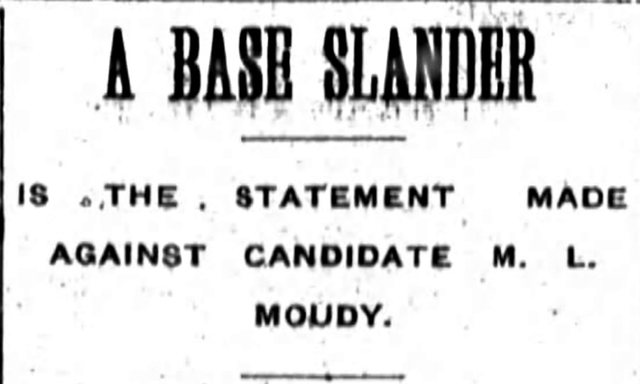
The Fort Wayne Journal-Gazette, October 27, 1900. See the clipping
In 1900 the Journal-Gazette described the home of the township’s trustee, M. L. Moudy, as “situated on the banks of the St. Joe river, at Hurshtown, where Mr. Moudy owns and operates the Urbana flour mills, and a saw mill adjoining, operated by steam and water, as the river is dammed at that point.”
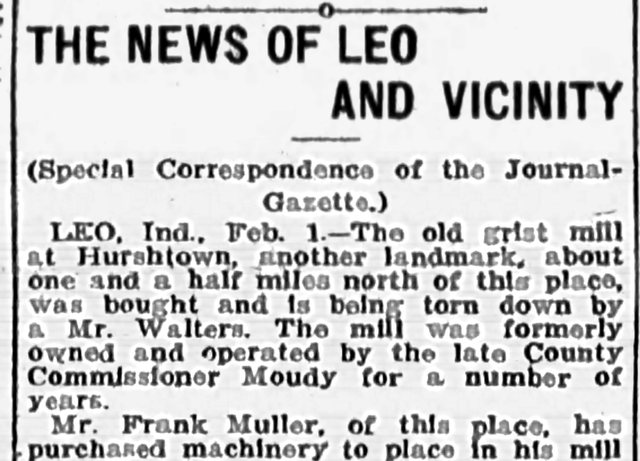
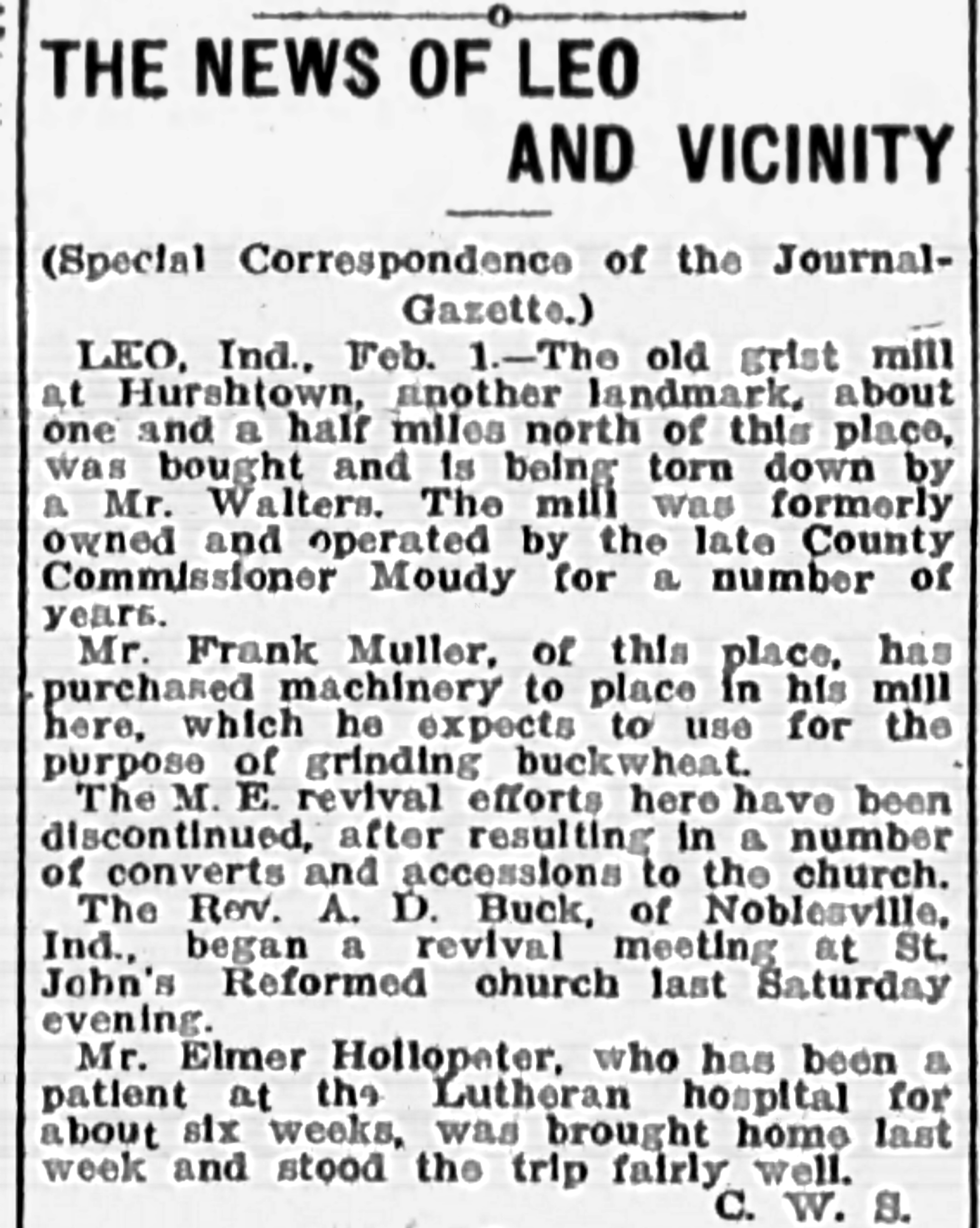
The Fort Wayne Journal-Gazette, February 2, 1909. See the clipping
In February 1909 the Leo correspondent reported that “the old grist mill at Hurshtown, another landmark,” was being torn down. It had been “formerly owned and operated by the late County Commissioner Moudy.”
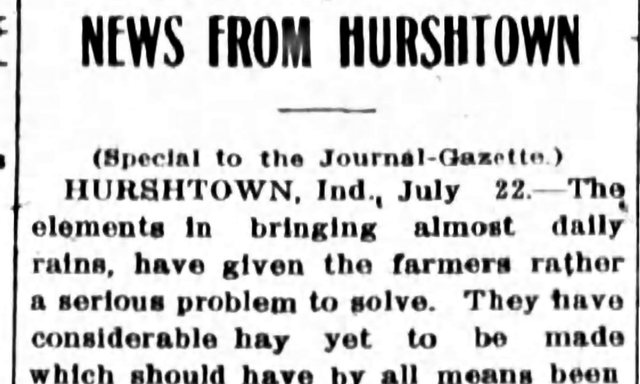
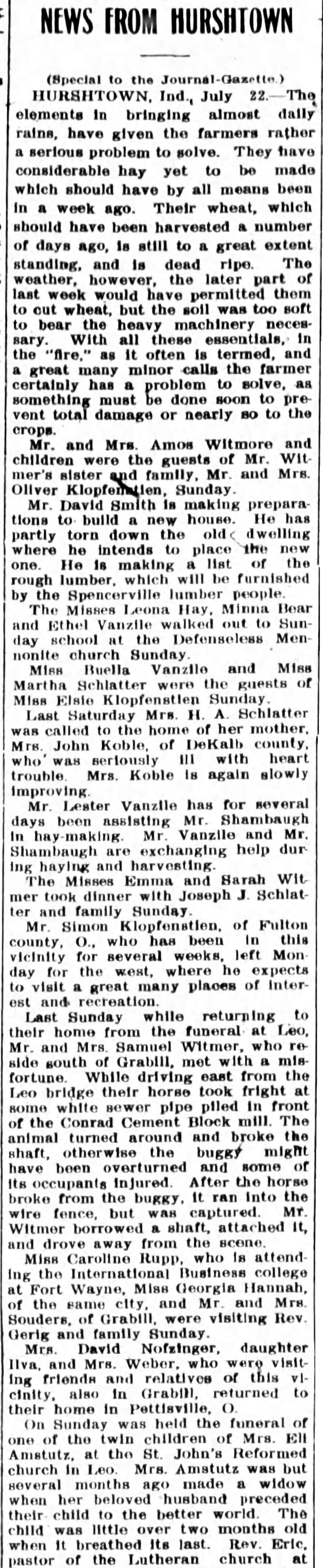
In July 1907 a column datelined “HURSHTOWN, Ind.” reported wheat “dead ripe” in rain-soaked fields, Sunday visits, a new house going up, and a horse that took fright near the Leo bridge.
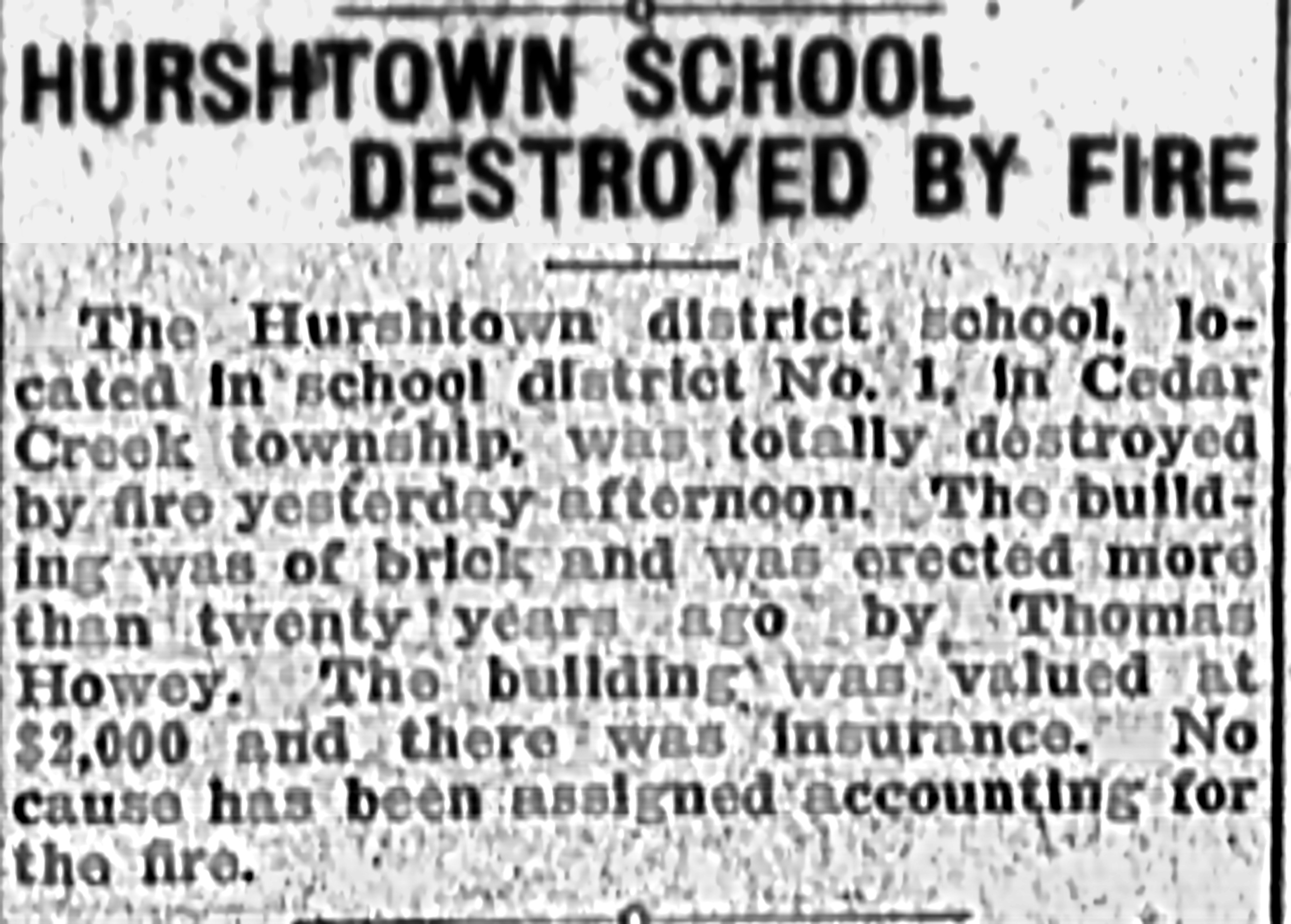
The Fort Wayne Journal-Gazette, November 25, 1909. See the clipping
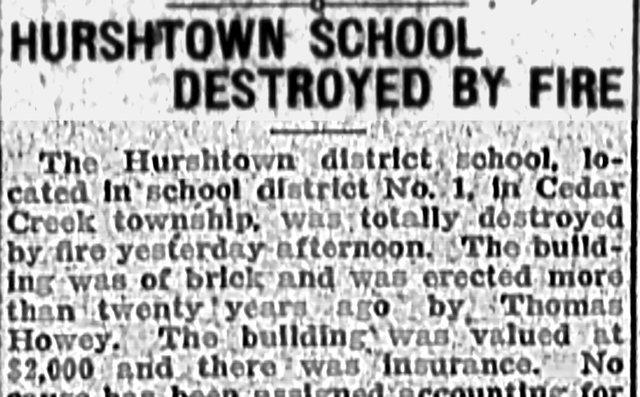
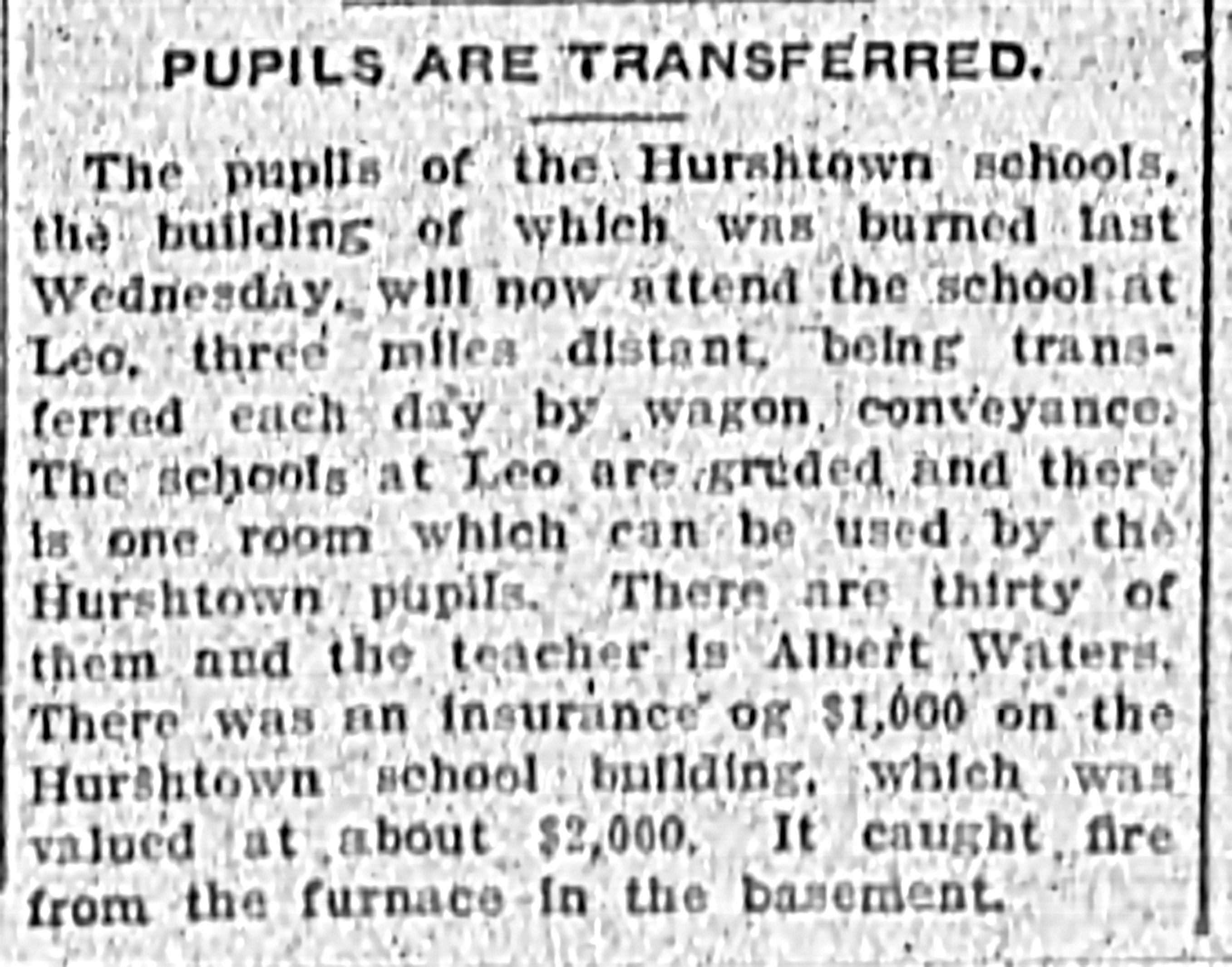
In November 1909 the Hurshtown district school, a brick building more than twenty years old, “was totally destroyed by fire.” Its thirty pupils were sent to the school at Leo, “being transferred each day by wagon conveyance.” The papers put Hurshtown “about one and a half miles north” of Leo in February and “three miles distant” in November; they don’t explain the difference.
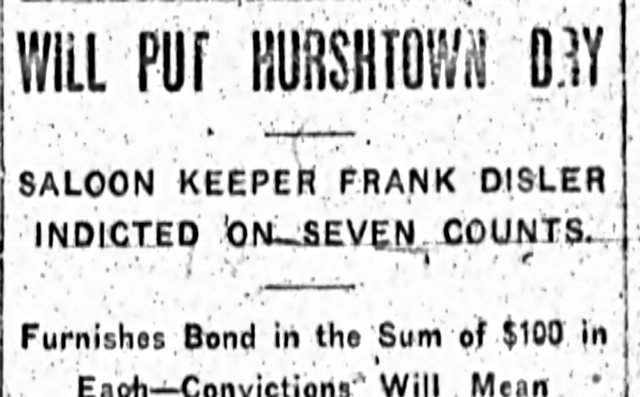
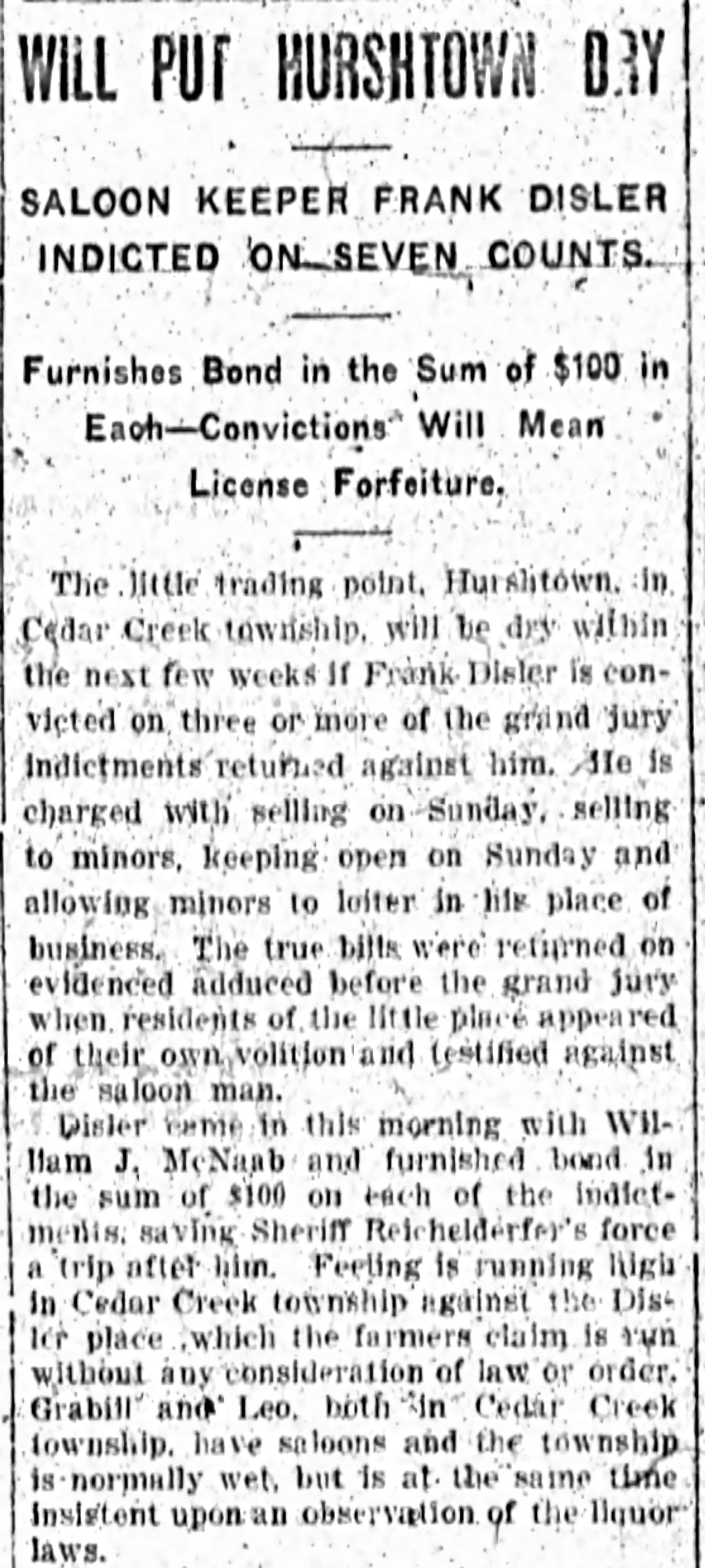
In October 1911 residents of Hurshtown went before the grand jury “of their own volition” and testified against the local saloon keeper, who was indicted on seven counts. The paper said Hurshtown would “be dry within the next few weeks” if he were convicted. No verdict has been found.
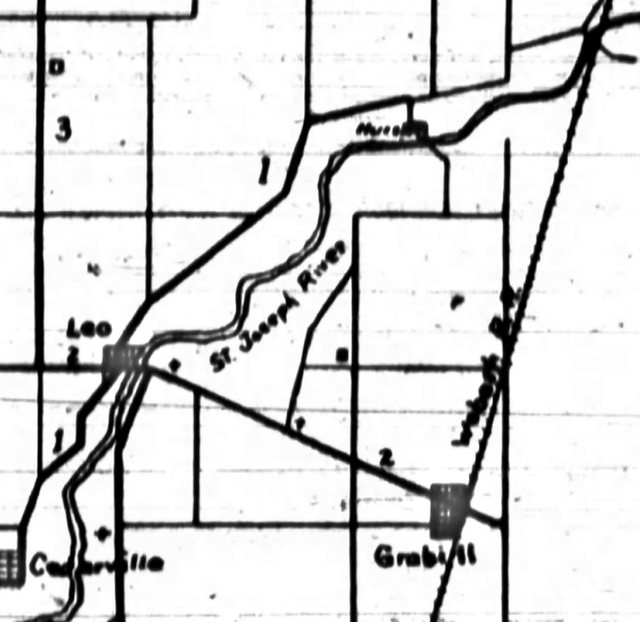
The 1911 Good Roads map: road “1” runs northeast from Leo to Hurshtown (upper right). See the map
That December, the Good Roads map still named Hurshtown as the end of a proposed stone road from the Cedar Creek bridge at Cedarville, “a distance of about four miles.” And the trustee’s report for 1912 lists payments to Eck Hursh for “labor on road” and to Nellie Hursh for “teaching No. 2.”
Unofficial transcription, prepared from the archive scan for ease of reading, copying, and searching. The printed page is authoritative. Original spelling, punctuation, and paragraphing are preserved. Nothing has been corrected or modernized.
Bad Work at Hurshtown.
To the Editor of THE SENTINEL:
There is a small village in the northern part of Allen county, by the name of Hurshtown, which is the ruination of many of our promising young men. They meet at a certain place in the village for the purpose of gambling, smoking and drinking. The liquor which curses them, is sold principally without a license, and contrary to law, is kept and disposed of in the same building where the postoffice is. Let this be a warning to the liquor dealer. If such practices are not discontinued the officers will be notified.
AN EYE WITNESS.
Notes
"which." In "The liquor which curses them" the last letters of "which" are broken on the film (they look like "whiclr"). The reading is certain from context.
About this clipping
Source
The Fort Wayne News and Sentinel (Fort Wayne, Indiana), February 20, 1889, page 3.
Archive
Newspapers.com, image 29351754 (subscription site). The images and transcription on this page are complete and free to use.
Copyright
Published in the United States before 1931 and in the public domain.
Images
Cleaned from the archive scan for legibility.
Transcription
Prepared by Robert J. Pfister, October 2026, and checked word by word against a magnified view of the scan.
By the Wayside
The Fort Wayne Journal-Gazette, Thursday, June 28, 1894, page 4.
Partisan correspondence of its day, signed with a pen name. It is reproduced as printed; it does not reflect the views of this site.
Unofficial transcription, prepared from the archive scan for ease of reading, copying, and searching. The printed page is authoritative. Original spelling, punctuation, and paragraphing are preserved. Nothing has been corrected or modernized.
BY THE WAYSIDE.
Notes Taken by Rawsby All Along the Line—Situation in Cedar Creek.
"There wanst was three cats of Kilkenny, 'Nd aich cat thought 'twas one cat too many, So they quarreled 'nd they fit, 'Till exceptin' their nails, 'Nd the tips of their tails, Instead of three cats there wer-rent any."
This melo-dramatic history of Kilkenny has been paralleled in the fight of the Democratic bosses in old Cedar Creek.
* * *
The fight here had its origin at the primary held in Leo early last spring for the selection of the Democratic township ticket, when by some means inexplicable except to the tellers, Barve, the choice of the majority of the Democrats present, "was relegated to the rear," and Mark Mowdy, the boss of the Hurshtown gang, placed at the head of the ticket. Metcalf, the candidate for assessor, is also a "Hurshtown hoodlum," and it is the insolent boast of the Hurshites that "Hurshtown is on top this year and running things to suit herself and that Leo and Cedarville can either like it or lump it, for all the good it will do them."
* * *
The Democracy of the southern part of the township felt pretty sore at being counted out, as they believe, of their choice of candidates for trustee and assessor, but probably most of them were too loyal Democrats or else hadn't courage enough to oppose their party's ticket, had the Hurshtown crowd not "added insult to injury" by bringing out McCroy as candidate for commissioner and thus defeating Treace, of Cedarville. This last was "the straw that broke the camel's back," and now these southern Democrats declare they will follow the example set by the law and order faction of the Fort Wayne Democracy in last spring's election and help defeat a ticket which they believe to have been nominated by unfair means.
* * *
That Mowdy, the nominee for trustee by the anti-Barve faction, is a "good enough fellow" as far as that term goes, no one denies. But that his education or habits mark him as a man exceptionally well qualified for the place, even his best friends do not claim. They say, however, that "if Mark is elected he will do the best he knows how, and that no matter how bad that may be it will be an improvement on the past administration of affairs." But of his election there is little danger, for although Barve may not have nerve enough to come out as an independent candidate, his friends and Treace's friends are numerous enough and angry enough to defeat the ticket, just to show the Hurshtown gang they do not own the township.
* * *
Barve, the defeated candidate, owes his present position as trustee to appointment, and is, therefore, eligible to succeed himself. He is a fair scholar a shrewd politician and can invent more opprobrious terms for his Republican neighbors than any other Democrat in the township. That he is a man of courage is proved by his frequent appearance in justice courts in the role of a defendant in assault cases. In fact he is a man morally and physically, excellently well qualified for a leader of the untamed Democray of Cedar Creek, and when the Cedar Creek Democrats refuse to be led we must say it is opposed to the eternal fitness of things and more their misfortune than Barve's fault. Barve was entitled to the nomination and worked hard to secure it, and now to find himself knocked out and another fellow standing in his shoes is more than flesh and blood can stand, especially flesh and blood of the Barve type, so war is declared—"war to the knife." "Lay on McDuff," etc.
RAWSBY.
Notes
"BY THE WAYSIDE." The first letter of the headline is damaged on the film ("bY"); the reading BY is certain.
Misprints kept as printed: "Democray" (for Democracy) and "McDuff" (for Macduff).
About this clipping
Source
The Fort Wayne Journal-Gazette (Fort Wayne, Indiana), June 28, 1894, page 4.
Archive
Newspapers.com, image 29017619 (subscription site). The images and transcription on this page are complete and free to use.
Copyright
Published in the United States before 1931 and in the public domain.
Images
Cleaned from the archive scan; the headline and ending were joined from separate downloads.
Transcription
Prepared by Robert J. Pfister, October 2026, and checked word by word against a magnified view of the scan.
A Base Slander
The Fort Wayne Journal-Gazette, Saturday, October 27, 1900, page 1.
A partisan campaign item of its day, in the paper’s own voice. It is reproduced as printed; it does not reflect the views of this site.
Unofficial transcription, prepared from the archive scan for ease of reading, copying, and searching. The printed page is authoritative. Original spelling, punctuation, and paragraphing are preserved. Nothing has been corrected or modernized.
A BASE SLANDER
IS THE STATEMENT MADE AGAINST CANDIDATE M. L. MOUDY.
The Falsehood is Secretly Circulated That His Management of Cedar Creek Township Leaves it in Debt Various Sums—Instead He Wiped Out an Indebtedness of $5,800 and Built a New School—An Honest Man in the Highest and Best Sense of the Word.
Some one, it is impossible to trace its origin, is telling, when he thinks the falsehood is safe, that Mr. M. L. Moudy has placed an indebtedness of sums all the way from $7,000 to $12,000 on Cedar Creek township, where he is now serving as trustee.
When Mr. Moudy was elected trustee of Cedar Creek township five years ago he found an indebtedness of $5,800.
To-day Cedar Creek township is free from indebtedness, a handsome new school house has been added, making twelve in all, and he is ready to step down and out of office with the township levy as it has been—a record that bespeaks not only a competent and painstaking public officer, but as well an honest man.
Mr. Moudy is the candidate on the democratic ticket for county commissioner from the second district. His modest country home is situated on the banks of the St. Joe river, at Hurshtown, where Mr. Moudy owns and operates the Urbana flour mills, and a saw mill adjoining, operated by steam and water, as the river is dammed at that point.
Not only in an official way but in a business way Mr. Moudy enjoys the respect of the people of the northern part of the county where he is best known, in fact his neighbors speak of him as "Honest Mart Moudy."
The last report as township trustee filed by Mr. Moudy, September 1, last, shows outstanding orders for all purposes amounting only to $59, and this was because they were not presented promptly, for the cash on hand, according to his sworn statement, is $2,114.31, and the report is approved by the Cedar Creek township council, Jerry Klopfenstine, Eugene Cook and Frank Moss.
Mr. Moudy's management of the affairs of Cedar Creek township is above and beyond criticism, and if the parties who are circulating the falsehoods about him will disclose their identity, the Journal-Gazette will not hesitate to denounce them as unworthy of the votes of honest men, for they must have some political purpose in libeling a good citizen and an upright man.
Mr. Moudy is not in the city often, and they hoped the slanders would escape him and his friends.
Mr. Moudy's record is an open book and the Journal-Gazette will gladly pay for an investigation by any committee the republicans will name if every word uttered above is not absolutely true.
Notes
"Klopfenstine." As printed.
"$2,114.31." The first "1" is slightly damaged on the film but certain.
About this clipping
Source
The Fort Wayne Journal-Gazette (Fort Wayne, Indiana), October 27, 1900, page 1.
Archive
Newspapers.com, image 29112583 (subscription site). The images and transcription on this page are complete and free to use.
Copyright
Published in the United States before 1931 and in the public domain.
Images
Enhanced from the archive’s clipping download (the only resolution available for this narrow column).
Transcription
Prepared by Robert J. Pfister, October 2026, and checked word by word against a magnified view of the scan.
News from Hurshtown
The Fort Wayne Journal-Gazette, Tuesday, July 23, 1907, page 4.
Unofficial transcription, prepared from the archive scan for ease of reading, copying, and searching. The printed page is authoritative. Original spelling, punctuation, and paragraphing are preserved. Nothing has been corrected or modernized.
NEWS FROM HURSHTOWN
(Special to the Journal-Gazette.)
HURSHTOWN, Ind., July 22.—The elements in bringing almost daily rains, have given the farmers rather a serious problem to solve. They have considerable hay yet to be made which should have by all means been in a week ago. Their wheat, which should have been harvested a number of days ago, is still to a great extent standing, and is dead ripe. The weather, however, the later part of last week would have permitted them to cut wheat, but the soil was too soft to bear the heavy machinery necessary. With all these essentials, in the "fire," as it often is termed, and a great many minor calls the farmer certainly has a problem to solve, as something must be done soon to prevent total damage or nearly so to the crops.
Mr. and Mrs. Amos Witmore and children were the guests of Mr. Witmer's sister and family, Mr. and Mrs. Oliver Klopfenstien [?], Sunday.
Mr. David Smith is making preparations to build a new house. He has partly torn down the old dwelling where he intends to place the new one. He is making a list of the rough lumber, which will be furnished by the Spencerville lumber people.
The Misses Leona Hay, Minna Bear and Ethel Vanzile walked out to Sunday school at the Defenseless Mennonite church Sunday.
Miss Buella Vanzile and Miss Martha Schlatter were the guests of Miss Elsie Klopfenstien Sunday.
Last Saturday Mrs. H. A. Schlatter was called to the home of her mother, Mrs. John Koble, of DeKalb county, who was seriously ill with heart trouble. Mrs. Koble is again slowly improving.
Mr. Lester Vanzile has for several days been assisting Mr. Shambaugh in hay-making. Mr. Vanzile and Mr. Shambaugh are exchanging help during haying and harvesting.
The Misses Emma and Sarah Witmer took dinner with Joseph J. Schlatter and family Sunday.
Mr. Simon Klopfenstien, of Fulton county, O., who has been in this vicinity for several weeks, left Monday for the west, where he expects to visit a great many places of interest and recreation.
Last Sunday while returning to their home from the funeral at Leo, Mr. and Mrs. Samuel Witmer, who reside south of Grabill, met with a misfortune. While driving east from the Leo bridge their horse took fright at some white sewer pipe piled in front of the Conrad Cement Block mill. The animal turned around and broke the shaft, otherwise the buggy might have been overturned and some of its occupants injured. After the horse broke from the buggy, it ran into the wire fence, but was captured. Mr. Witmer borrowed a shaft, attached it, and drove away from the scene.
Miss Caroline Rupp, who is attending the International Business college at Fort Wayne, Miss Georgia Hannah, of the same city, and Mr. and Mrs. Souders, of Grabill, were visiting Rev. Gerig and family Sunday.
Mrs. David Nofzinger, daughter Ilva, and Mrs. Weber, who were visiting friends and relatives of this vicinity, also in Grabill, returned to their home in Pettisville, O.
On Sunday was held the funeral of one of the twin children of Mrs. Eli Amstutz, at the St. John's Reformed church in Leo. Mrs. Amstutz was but several months ago made a widow when her beloved husband preceded their child to the better world. The child was little over two months old when it breathed its last. Rev. Eric, pastor of the Lutheran church at Spencerville, preached the funeral.
Notes
"Klopfenstien" in the Witmore paragraph. A scratch on the film crosses the middle of the name ("Klopfen–tien"). It is printed "Klopfenstien" twice elsewhere in the column, and that is the reading here; the middle letters can't be confirmed.
"Witmore" and "Witmer." The same paragraph prints "Mr. and Mrs. Amos Witmore" and then "Mr. Witmer's sister." Kept as printed.
"Klopfenstien." As printed (the more usual spelling is Klopfenstein).
About this clipping
Source
The Fort Wayne Journal-Gazette (Fort Wayne, Indiana), July 23, 1907, page 4.
Archive
Newspapers.com, image 29334971 (subscription site). The images and transcription on this page are complete and free to use.
Copyright
Published in the United States before 1931 and in the public domain.
Images
Cleaned from the archive scan; captured in two overlapping sections and joined.
Transcription
Prepared by Robert J. Pfister, October 2026, and checked word by word against a magnified view of the scan.
The News of Leo and Vicinity
The Fort Wayne Journal-Gazette, Tuesday, February 2, 1909, page 7.
The Leo column as printed; the Hurshtown mill is the first item. Click to enlarge.Download column
Transcription
Unofficial transcription, prepared from the archive scan for ease of reading, copying, and searching. The printed page is authoritative. Original spelling, punctuation, and paragraphing are preserved. Nothing has been corrected or modernized.
THE NEWS OF LEO AND VICINITY
(Special Correspondence of the Journal-Gazette.)
LEO, Ind., Feb. 1.—The old grist mill at Hurshtown, another landmark, about one and a half miles north of this place, was bought and is being torn down by a Mr. Walters. The mill was formerly owned and operated by the late County Commissioner Moudy for a number of years.
Mr. Frank Muller, of this place, has purchased machinery to place in his mill here, which he expects to use for the purpose of grinding buckwheat.
The M. E. revival efforts here have been discontinued, after resulting in a number of converts and accessions to the church.
The Rev. A. D. Buck, of Noblesville, Ind., began a revival meeting at St. John's Reformed church last Saturday evening.
Mr. Elmer Hollopeter, who has been a patient at the Lutheran hospital for about six weeks, was brought home last week and stood the trip fairly well.
C. W. S.
About this clipping
Source
The Fort Wayne Journal-Gazette (Fort Wayne, Indiana), February 2, 1909, page 7.
Archive
Newspapers.com, image 29193697 (subscription site). The images and transcription on this page are complete and free to use.
Copyright
Published in the United States before 1931 and in the public domain.
Images
Cleaned from the archive scan for legibility.
Transcription
Prepared by Robert J. Pfister, October 2026, and checked word by word against a magnified view of the scan.
Hurshtown School Destroyed by Fire
The Fort Wayne Journal-Gazette, Thursday, November 25, 1909, page 7. Follow-up: The Fort Wayne News and Sentinel, Saturday, November 27, 1909, page 1.
The Journal-Gazette, November 25, 1909. Click to enlarge.DownloadThe follow-up in the News and Sentinel, November 27, 1909. Click to enlarge.Download
Transcription
Unofficial transcription, prepared from the archive scan for ease of reading, copying, and searching. The printed page is authoritative. Original spelling, punctuation, and paragraphing are preserved. Nothing has been corrected or modernized.
HURSHTOWN SCHOOL DESTROYED BY FIRE
The Hurshtown district school, located in school district No. 1, in Cedar Creek township, was totally destroyed by fire yesterday afternoon. The building was of brick and was erected more than twenty years ago by Thomas Howey. The building was valued at $2,000 and there was insurance. No cause has been assigned accounting for the fire.
PUPILS ARE TRANSFERRED.
The pupils of the Hurshtown schools, the building of which was burned last Wednesday, will now attend the school at Leo, three miles distant, being transferred each day by wagon conveyance. The schools at Leo are graded [?] and there is one room which can be used by the Hurshtown pupils. There are thirty of them and the teacher is Albert Waters. There was an insurance og $1,000 on the Hurshtown school building, which was valued at about $2,000. It caught fire from the furnace in the basement.
Notes
"graded." The word is printed with a broken letter and looks like "gruded"; "graded" (schools divided into grades, as opposed to a one-room district school) is the reading from context.
"og $1,000" — misprint for "of," kept as printed.
About this clipping
Source
The Fort Wayne Journal-Gazette (Fort Wayne, Indiana), November 25, 1909, page 7. Follow-up: The Fort Wayne News and Sentinel, November 27, 1909, page 1.
Unofficial transcription, prepared from the archive scan for ease of reading, copying, and searching. The printed page is authoritative. Original spelling, punctuation, and paragraphing are preserved. Nothing has been corrected or modernized.
WILL PUT HURSHTOWN DRY
SALOON KEEPER FRANK DISLER INDICTED ON SEVEN COUNTS.
Furnishes Bond in the Sum of $100 in Each—Convictions Will Mean License Forfeiture.
The little trading point, Hurshtown, in Cedar Creek township, will be dry within the next few weeks if Frank Disler is convicted on three or more of the grand jury indictments returned against him. He is charged with selling on Sunday, selling to minors, keeping open on Sunday and allowing minors to loiter in his place of business. The true bills were returned on evidenced adduced before the grand jury when residents of the little place appeared of their own volition and testified against the saloon man.
Disler came in this morning with William J. McNaab and furnished bond in the sum of $100 on each of the indictments, saving Sheriff Reichelderfer's force a trip after him. Feeling is running high in Cedar Creek township against the Disler place ,which the farmers claim is run without any consideration of law or order. Grabill and Leo, both in Cedar Creek township, have saloons and the township is normally wet, but is at the same time insistent upon an observation of the liquor laws.
Notes
"evidenced adduced" — misprint for "evidence adduced," kept as printed.
"William J. McNaab." As printed.
"DRY." The first letter of "DRY" in the headline is broken on the film; the reading is certain.
"place ,which" — the comma is misplaced in the paper; kept as printed.
About this clipping
Source
Fort Wayne Daily News (Fort Wayne, Indiana), October 2, 1911, page 10.
Archive
Newspapers.com, image 28931417 (subscription site). The images and transcription on this page are complete and free to use.
Copyright
Published in the United States before 1931 and in the public domain.
Images
Cleaned from the archive scan for legibility.
Transcription
Prepared by Robert J. Pfister, October 2026, and checked word by word against a magnified view of the scan.